Thursday, February 5, 2009
Noisy drainpipes
Wednesday, February 4, 2009
Cover crops/Mustard/Anna
Vineyard mustard: just for looks or does it serve a purpose?
It’s a neat little video. In the video, they make the point that mustard, in addition to adding to the beauty of the vineyards, is a cover crop. Much of the mustard you see in the vineyards is an indigenous plant that reseeds itself. But many growers also spread their own blend of cover crop seed, that may or may not include mustard.
Summarizing: Broadly defined, a cover crop is any … plant grown to improve any number of conditions associated with sustainable agriculture. Cover crops are fundamental, sustainable tools used to manage soil fertility, soil quality, water, weeds (unwanted plants that limit crop production potential), pests (unwanted animals, usually insects, that limit crop production potential), diseases, and diversity and wildlife, in agroecosystems. Agroecosystems are ecological systems managed by humans across a range of intensities to produce food, feed, or fiber. To a large degree, humans shape the ecological structure and function of natural processes that occur in agroecosystems. … Farmers choose to grow specific cover crop types and to manage them in specific ways based on their own unique needs and goals.
===============================
Every vineyard whose grapes go to Pina Napa Valley is planted with a cover crop. Deciding on what plants should be included in the cover crop blend has become a sophisticated science for premium wine vineyards.
The consulting service that Pina Vineyard Management uses made the following recommendations for our D’Adamo vineyard:
It’s been said that great wines are made in the vineyard. As you can see, the attention given to planting the best cover crops would support that argument.
When pressed, our winemaker said 90% of a wine is made in the vineyard. Sharp cookie, that Anna, and diplomatic, too. Anna is also quite the patriot. She once said that she loves this country. She said that, even though current law would prohibit her from ever becoming president. Why is that?
Ciao, Ranndy
Thursday, January 22, 2009
Drat those bats!
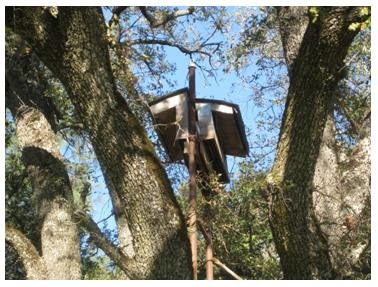
Greg surveyed the situation and built a bat house of his own design, to provide a more attractive alternative to our little friends. He mounted the house in the winery eaves. And it worked… sort of. The bats moved in and began multiplying and eventually overpopulated the house. Two years later, in 1997, Greg built a second bat house to accommodate the increased population and attached it close to the first bat house. And it worked… sort of. The bats moved in there and overpopulated that house, too. This only became evident during periods of extreme heat. To escape the congested habitat and extreme heat generated inside the house on those afternoons, large quantities of both infant and adult bats would move to the outside of the box and cling on to the outer surface as much as possible. It was very disturbing to witness the infants that would fall to the ground unable to navigate to escape the heat. Efforts to return them to their bat house would prove unsuccessful. In the winter of 1998, the houses were removed from the side of the winery and mounted back-to-back on steel poles partially shaded by Eucalyptus trees to provide a cooler site with better air flow. And it worked… sort of. The number of bats inhabiting these houses was estimated at between 600 & 900 at one point. Occasionally during the summer months, Cindy & I would have friends up to the winery right around sunset. We would set up aluminum chairs and sip wine while waiting for the bats to exit for their evening of feeding. First, one or two would come out followed by maybe 3 or 4 more. And then it was like the order was given to vacate the premises. Over the next minute, the bats poured out of the holes in continuous ribbons. It was very exciting to witness one of nature’s finest moments.
One summer period of extreme heat occurred so early in the day, that the houses were still in the full sun. I was saddened by yet another significant die back, mostly of infants. That winter, we relocated both houses, still on the poles, to the interior section of an old Oak tree by one of our vineyard blocks. This was to provide shade at all times of the day. And it worked… period.
I read with interest a recent article (By ROBERT DIGITALE) in the Santa Rosa Press Democrat about bats. Patricia Winters, president of the Forestville-based California Bat Conservation Fund gave a presentation to grape growers and pest workers on the value of bats in insect management.
The following excerpts are from that Press Democrat article.
RE: The Mexican Free-tailed bats
"She's a little bat," said Winters, known to Bay Area schoolchildren as the Bat Lady. "But she can fly faster than any other bat in the world. And she can fly up to two miles high, and all she eats are crop pests."
Winters showed graphics from Doppler radar and thermal imaging to depict billions of moths moving north from Mexico into southeast Texas at a height of almost two miles. Each night the moths run into what Winters called the largest concentration of mammals on the planet, an estimated 200 million Mexican free-tailed bats living in caves outside Austin and San Antonio.
Only 2 percent of the moths ever make it past the bats, which can fly at speeds of 60 mph, Winters said. One recent study estimated that the bats prevent about $1 billion a year in U.S. crop damage.
RE: Other bats
Winters told the group that a lactating Big Brown female bat, a species found in Sonoma County, can eat twice its weight in insects each night.
Kathy Cowan, who volunteers with Winters, said she has a standard argument for convincing women about the value of bats. She focuses on the work the animals do in pollinating tropical fruit and reseeding rain forests.
"If we didn't have bats," Cowan said, "we wouldn't have chocolate."
=================================================
Click here for the entire article and to see a great picture of a Pallid Bat:
http://www1.pressdemocrat.com/article/20081213/NEWS/812130315
Monday, January 19, 2009
The Black Sheep of the Pina Family
Black sheep is an English language idiom which describes an odd or disreputable member of a group, especially within one's family. The term has typically been given negative implications, implying waywardness.[1] It derived from the untypical and unwanted presence of black woolled individuals in herds of sheep, which was undesirable because wool from such sheep could not be dyed.
All four Pina brothers attended St. Helena public schools, and since there are only about six years separating us, we shared lots of the same teachers. One teacher that we all had was Martel Cooper. He taught the Ag Classes and metal shop. I liked Mr. Cooper, even though after one incident at school, he referred to me as the Black Sheep of the Pina Family. I accepted that he was accurate in his assessment, and carried that burden with me through the years. My guilt lessened over time as I heard more & more stories about the escapades that my brother John participated in. By comparison, my activities were quite tame. So maybe it’s a good thing that the word “sheep”, can be singular or plural. Because I’m convinced that in this instance, the Black Sheep of the Pina Family should be a shared title.
For most of our open–house type events, all four brothers will be there participating. I’ve had as many questions from of our visitors about the 4 brothers, and how they get along running the winery, as about the wine. We’re all very different, but we are able to have lively discussions at our weekly meetings and arrive at consensus decisions fairly well most of the time. Of course it’s easier, quicker and better if they just agree with my views early on in these discussions (And I’m still working at convincing them to adopt that philosophy).
One area we differ on, is our favorite Pina wine. I think I’m alone in preferring the D’Adamo over all the others. Now if I’m having steak or lamb, I might go with the Buckeye Howell Mountain Cab. But since that doesn’t happen very often, I drink more D’Adamo than all of our Howell Mountain, Oakville, Rutherford and Yountville Cabs combined.
With that in mind, I was pleased when the following blog was posted:
http://www.chow.com/wine_and_drinks/5570 (Updated on 1/20/2009)
D’Adamo was finally getting the recognition I felt it deserved. From this, I couldn’t be sure the writer would prefer the D’Adamo over the others. But he thinks it’s pretty good wine so I’ll accept the Don’t Ask/Don’t Tell strategy with his endorsement. In no way can/should it be considered a Black Sheep within the Pina wine family – Not sure I can say the same about brother John.
Thursday, January 15, 2009
Treading Lightly – The Kubota Secret
The Kubota SecretOver the years, Pina Vineyard Management (PVM) has had many Caterpillar tractors. They are great machines. In recent years, we’ve been adding some John Deere tractors to the fleet. The overwhelming factor when purchasing these tractors was function. They were chosen to get the job done, pure & simple. And PVM also has lots of Kubota tractors chosen for the same reason.
In the Spring of 2006, the local Kubota tractor dealership approached us with a unique proposal. Kubota had been working on a new tractor and they needed somebody to give it a well rounded field test: Work it hard, find its strengths & weaknesses – If you find problems, we want to know. Say no more, just give us the key. But, they said, there is one more thing:
After looking at the top picture, you may be wondering what the big secret is. It’s the side-view picture that will give you the answer.
Pina Cellars (in cooperation with Pina Vineyard Management) hosted the Kubota new tractor unveiling for the media and some local farmers. In the picture above, that’s brother Davie explaining our involvement with the project and describing our “testing” of the new Kubota Power Krawler.
You can check out the Kubota website for more information:
If you do, note the pictures that were taken in the PVM vineyard that sits high above Miner Winery. It’s a bit too steep to feel comfortable in most tractors.
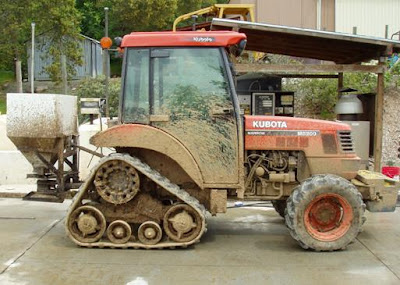
A growing concern among growers is soil compaction. Those old CAT D-2s looked pretty heavy, and they were, BUT the weight was distributed over a much larger area than today’s wheeled tractors. And that’s one of the big selling points of the new Kubota Power Krawler. It doesn’t compact the soil as much as a similar sized wheel tractor. How innovative of Kubota you say? Well, yes and no. It’s not like they invented the concept.
Photo courtesy
PVM gave the Krawler a thorough testing with several different implements and we were impressed. PVM now owns one of the new Kubota Power Krawlers, and will continue testing another production model for Kubota. Great machines – but I’m thinking the image of the driver sitting in a “climate controlled” cab with the high tracks visible while discing down the mustard is going to fall short of my recollections from the good old days.
Monday, January 5, 2009
Screw caps vs corks
Monday, December 29, 2008
Harvest 2008 by Anna Monticelli
During bloom, the extremely hot temperatures coupled with high winds made for a poor berry set. Although this greatly decreased our yields, we benefited from loose medium sized Cabernet clusters.
During the summer there were many wildfires here in Northern California. Many winemakers and viticulturalists worried about the possibility that the grapes could be tainted with smoke flavors. Thankfully, not only were our Piña vineyards unaffected, but I haven’t heard of any Napa Valley vineyards with this problem.
The 2008 vintage was approximately 1 week earlier than average. We had two heat-waves back to back at the beginning of harvest (end of August/early September). This resulted in some shriveled berries and very rapid sugar accumulation. These heat waves were also a contributing factor to the extremely low yields. Here at Piña Napa Valley, our grape yields are down approximately 40% lower than average.
After the initial heat waves, the weather remained very mild and temperate ensuring optimum slow ripening and extended hang time conditions. It rained on October 3rd into the 4th, but the amount of rain was very small and the good weather before and after the rain resulted in no negative effects on the crop.
At Piña Napa Valley, we began by harvesting the Ames and Firehouse vineyards on September 8th and the Stice’s Stone Corral vineyard on September 12th. We continued harvesting with the D’Adamo vineyard on September 26th. We made several harvest passes through the Wolff vineyard during September and October to ensure harvesting only perfectly ripe fruit. We picked the Buckeye vineyard on October 17th, 27th and 29th.
The resulting 2008 wines are very promising. They have great color accompanied by good tannin structure and mouth feel. There is good concentration and acidity. Although we may not have a lot to drink this year, it will surely be enjoyable.
Anna Monticelli
Winemaker
Piña Napa Valley
Thursday, December 11, 2008
Chip bud grafting / This Earth is mine
He starred in a movie called This Earth Is Mine (released June,1959). Lots of the filming for this movie was done in the Napa Valley, especially in the Yountville, Oakville & Rutherford areas. It’s not considered a great movie, but it’s kind of fun to catch some glimpses of the Napa Valley landscape from 50 years ago. For those of you that haven’t peeked ahead for the answer, Rock Hudson was Leroy Harold Scherer, Jr. at birth. “Rock Hudson? Who’s that?” My 22 year old son Tyler asked.
I won’t go into the plot, but there is a scene where Rock needed to perform a fairly specialized procedure in vineyard operations – Chip bud grafting (AKA budding). Budding is the process of attaching a bud from one plant to rootstock. Rootstock is defined as a plant onto which another plant is grafted. There are lots of different rootstocks available, all with different characteristics. Some are more resistant to pests, Some handle wet or dry conditions better than others. And they tend to have no-nonsense names. Our Firehouse vineyard has 110R, 420A and 3309 rootstock. Once the rootstock has been decided, any variety of grapes can be grafted onto it. Cabernet, Chardonnay and Zinfandel can all use the same type of rootstock. For that matter, you could add a bud from each of these varieties onto the same rootstock for a vine that would produce 3 different types of grapes. Don’t know why you would want to do that, but it is possible. Not to further confuse anybody, but there are several clones of grape varieties, too. Our Firehouse vineyard has Cabernet Sauvignon clones of 2, 4, 8 & 337. The possible combinations of rootstock & varietal clone are almost endless.I’ll follow this up with some pictures that should make the process easier to understand. Back to the movie: They needed somebody to teach Rock how to bud, and since he was left handed, they needed a teacher that was left handed… and this is where my great uncle Jim Pavon, enters the picture (figuratively speaking, only). He taught Rock how to bud well enough to pass for the movie. Rock even used Jim’s budding box & knife in the movie. I have always found this skill interesting, but apparently not as much as my brother Larry. Larry claims that when he was around 8 years old, he spent a fair amount of time budding and trying to get vine buds to grow. And he wasn’t going to be limited by conventional thinking. He budded vine buds onto Eucalyptus trees. Our dad told him it wouldn’t work, but he proceeded undeterred, and would give our dad daily updates on his project. Those are the trees visible directly across from the Plumpjack Winery tasting room. They appear to have survived Larry’s experiments, but we won’t be releasing a Cabalyptus wine anytime soon.
Did I mention that in-the-vineyard chip budding is hard on the back? This highly skilled work must be done on your knees. The chip bud grafting process is illustrated with pictures below taken by my brother, John C. Piña.
First, a varietal bud is cut from a pruned cane from a mature vine.
(This is an action photo - see it flying through the air?)
Then the 1st cut on the rootstock is made
2nd cut above first cut
2nd cut extends down to the first cut
And when that little section is removed,
the opening has been created for the chip bud
The chip bud is positioned in the opening
A tight fit is critical for the bud to grow*
This fit required an extra sliver of rootstock to be removed
Once the fit is perfect, a lightweight stretchy vinyl tape is wrapped around the new union to keep the new bud tightly embedded into the rootstock
And the top of the rootstock is cut off to force the rootstock to devote all of the growth energies into the bonding and growth of the bud
* After reviewing this post for accuracy at my request, John noted that while a tight bud fit is important, more important is getting part of the cambium layer of the bud to line up with the cambium layer of the rootstock.
=========================================
There are newer methods of grafting that are not quite so labor intensive, or skilled. Click on the following link to Practical Winery & Vineyard magazine for a more comprehensive overview of the options available.
Great info there, but John’s pictures are better!
Wednesday, December 10, 2008
California's Best Wines of 2008
Wine News has rated our 2005 Buckeye as one of California’s top 10 Cabs of 2008.
In their words:
Pina, 2005 Cabernet Sauvignon, Buckeye Vineyard, Howell Mountain, Napa Valley - Minty maraschino cherry aromas with hints of resin and cinnamon. Supple strawberry preserve flavors with a thick, nearly chewy texture. There is a richness front to back in this Cabernet with the wood tannins, fruit and minerals meshing nicely in the close. Drinking nicely right now and should continue to improve.
Very flattering and we are the least expensive wine on the list.
Click here for the full story:
http://www.thewinenews.com/current/feat.asp
Thursday, December 4, 2008
Piña vs Pina – The Typewriter years/Casket Factory
http://en.wikipedia.org/wiki/Image:Typewriters.jpg#file
So Joe (No, the structural engineer, NOT the plumber) tells me that he ran into somebody that knew me from high school. But that guy knew me as Ranndy Pina (pronounced pee-nuh), not Ranndy Piña (pronounced peen-yuh). So, what’s that about?
Piña vs Pina – Let me explain. My grandfather left Spain as Juan Mena Piña. He accepted the first name change to John in America, but he would never give up the Piña. But slowly, over the next half century, the name Piña would evolve into Pina for nearly all written communication. Some might say that was the expected Americanization of a foreign name. I think it had more to do with the typewriterization (yea, I just made that word up) of a foreign name. You see, that little squiggly thing (~) over the n in Piña is called a tilde.
Tilde is defined as: “a diacritic (~) placed over an n, as in Spanish mañana, to indicate a palatal nasal sound”
Tildes may have found their way onto typewriters in Spain and Mexico, early on, but not here in the good ‘ole U. S. of A. So without the tilde, folks had a tough time typing Piña and it would come out as Peenya, or something equally as bad. So for many years, we just accepted Pina. Eventually, typewriters and word processors added the tilde and we started the transition back to Piña. Using the tilde got even easier with the development of computers, but it also created some problems. Searching this document or the internet for “Piña” will yield different results that searching for “Pina”. Even now, some fonts & document formats can’t deal with the ñ, and will substitute some other symbol or just leave it out altogether. So even though Piña is the correct spelling, we will frequently just use Pina.
===================================
But we thank The Cork Board for giving it a try. Now that's a blog worth reading. If you haven't checked it out, I recommend it.
Most online dictionaries will interpret Piña as Spanish for Pineapple, but we prefer the less common interpretation to Pine cone, or fruit of the Pine. After all, we’re talking Spain.
We even incorporated pine cones into our first 2 labels.
This was the label we put on our 1st wine, a 1979 Chardonnay:
We upgraded our label a few years later and the
Pine cones were embossed on the label
Yes, our first wine was a 1979 Chardonnay. We made it in a bonded winery on Action Ave. in Napa, of all places* (see my related story at the end). We were making some great wines through the 80’s, but even great wines don’t sell themselves. The Pina brothers did what they could, but the vineyard management company was growing too quickly and requiring too much time. After several years, we realized it was unrealistic to think our one employee could handle the winemaking and the sales. We had to let our one employee go and take a break from making (commercial) wine for several years. We leased space to other startup operations through the 1990’s. When we realized just how good the Cabernet was from the Howell Mountain Buckeye Vineyard, we decided it was time to get back into wine production.
Below is the original sign for Pina Cellars. Yes, some of you will recognize it as our current tasting bar. It was made from the barrel staves of a large redwood tank.

For Piña Napa Valley (AKA Piña Cellars 2.0), we decided to use
a tilde, or more specifically a red tilde, as our trademark.
=====================================
The Winery under Construction
Summer 1982 - Placing the 48’ long main beam (Davie on the forklift, Dad, John C.)

July 3rd, 1982 – Davie on the scaffold, Ranndy on the roof
Here is the story that I alluded to earlier:
It was a Wednesday morning in October, 1979 and I was waiting outside the winery on Action Ave for the owner to show up. His converted warehouse was right next to a casket factory that employed several special needs people. The special needs people started showing up for work and were waiting outside the building for it to open. I sat in my car facing away from these folks, but monitoring their arrivals in my rear view mirror. Then I saw him approach. He appeared severely disfigured, but I continued to look on as many folks do when passing a bad accident on the highway. I felt so sorry for him – That poor guy, having to go through life looking like that. As he approached the waiting group, they didn’t seem at all upset by his appearance – In fact they seemed quite happy to see him. They laughed and gave him high fives! I’m thinking: Wow, is this the reception he gets every morning? Then he put his hand up to his face and removed his mask. I felt duped. How could I have forgotten it was the 31st of October – Halloween! And then I reluctantly accepted the possibility that he was enjoying life more than me. It was a very humbling experience that I remember vividly 29 years later.