Tuesday, March 31, 2009

NEWS FLASH! Vast butterfly migration reported


A painted lady butterfly stops to catch a quick snack on Monday, March 30, 2009 in Martinez, Calif. Millions of the small butterflies are migrating north. (Jose Carlos Fajardo/Staff) ( JOSE CARLOS FAJARDO )

Hey folks, if you've signed up to be notified by email of new posts, this might get to you in time to witness a natural phenonem:

Vast butterfly migration reported in the Bay Area

My good friends, Joe & Lori (Sis) Bauer just called to report swarms of butterflies passing through the Yountville area. They reported seeing several crows feasting on the Painted Lady butterflies above town. Joe sent this picture:


And my co-worker, Omar Cruz, reported a splattering of them hitting his windshield as he returned to the office.

If you are in the Napa Valley, take a break and go outside. I was seeing 4 or 5 per minute, but in many areas they are much more concentrated.

Check out the article in the Silicon Valley Mercury News:

Wednesday, March 25, 2009

The Piña Plucker


The Piña Plucker By John Pina


In the harvest of 2002 we experienced some sun-burnt fruit at our Buckeye Vineyard due to an extended period of hot dry weather just before harvest. Our winemaker, Cary Gott, was concerned so we asked the picking crew to drop fruit that had significant shriveled berries. The result was clean fruit for the winery but significantly less due to the amount dropped.
The 2003 harvest experienced similar hot dry weather, again burning the berries exposed to the afternoon sun. Cary and I looked at the vineyard the day before our planned pick and again we were concerned with the amount of shriveled berries. The plan was to again go through the vineyard the morning of harvest and drop any burnt bunches.
As I was driving home that evening I considered the options and came up with a plan. I drove straight to the second-hand store in Healdsburg and bought all the forks they had on hand. I then went home to my shop and started cutting and bending the prongs to fashion a suitable berry removal tool. I took two forks and riveted them together facing opposite directions. One fork retained all four prongs, but they were bent as a uniform rake. The fork on the other end retained only the two center prongs that were also bent to form a two prong rake. The idea was to use the full rake to remove all the berries on a burnt bunch while the two prong rake was used to remove individual burnt berries. I worked late to produce a dozen of these “pluckers” so that there would be more than enough to supply one to each member of the harvest crew the next morning.
The next morning when I presented the tools to the crew, I’m sure they thought I had lost it. I explained that the purpose of the tool was to remove only shriveled berries rather than the whole bunch. Of course, it was easy to find the burnt berries as they are only on the side of the bunch that got the hot afternoon sun. It only took a few minutes before they were comfortable with its use and made extremely good time going through the vineyard.
The next generation of pluckers is still two stainless forks but now they are tightly welded together.
We began to share these tools with our vineyard management company clients and even considered having them commercially produced. Modified VSP trellis systems have reduced the need for this tool lately.
John C. Piña
Spring 2009

Thursday, March 19, 2009

Home winemakers vs. Premium wines


Question & Answer time again – Question: What’s the difference between God & Winemakers?
The Answer will be at the end of this blog. My apologies in advance to Anna, Macario, and perhaps 3 or 4 other winemakers for dredging up this old witticism.

Some of you may have assumed from that title there would be some terroir tossing (AKA mud slinging). Nope, I'm not going there.

I wouldn’t call myself a winemaker, but I did make wine for several years. I used to refer to myself as a “recipe” winemaker. I would make wine following the instructions from various printed sources. All along the way I would ask more learned people than myself to taste the wine and tell me what the wine test analysis numbers meant and what I should do to correct any irregularities or problems. I doubt the wines would have won any awards in competitions, but I thought they turned out quite well.
The first wine I made was with “second crop” Cabernet Franc grapes. Answers.com defines second crop grapes as “Grapes from clusters where
flowering took place noticeably after the main flowering. This group of grapes will not mature with the first group and will still be unripe during the initial harvest. If growers are willing to wait until this second crop matures, the quality can be excellent, but it is often so small that it's not cost-effective to pick.”
So these second crop grapes were free for the picking. The main crop had been picked weeks earlier, but the rains had held off and these late blooming small clusters with small berries eventually matured. The small berries, combined with a long hang time turned out to be a great combination, and the resulting wine was one of my best efforts. Free, second crop grapes used to be the fruit of choice for local home winemakers.


The following is from one of my first blogs: Grape Contracts Past & Present;
“…One other thing to consider is that the ripeness of the grapes varied from bunch to bunch and vine to vine more than today’s premium wine vineyards. Some winemakers feel the most important factor for quality grapes is a uniform crop. Today, most vineyards receive more time and attention than those of past years, at least in the premium wine category. There is much more emphasis on canopy management, sun exposure, water management and selective fruit thinning. Probably the biggest contribution to a uniform crop is the selective fruit thinning. Selective fruit thinning is when small bunches, and less-ripe bunches, and excessive numbers of bunches are cut off the vine to promote uniform ripening of the rest of the crop. This is not done without a bit of anguish. Imagine paying all year long for the best care of your vineyard, only to have to PAY MORE to have some of the fruit cut off and just fall to the ground.”

So, over the years, more & more premium wine grape growers began cutting off these “second crop” grapes long before the first crop reached maturity. As a result, many home winemakers lost their sources of “free” grapes, and were forced to look elsewhere. And if that wasn’t damaging enough, many growers will no longer risk the liability of allowing non-employees access to their vineyards – They have nothing to gain and everything to lose.

Now, the answer to the question:

What’s the difference between God & Winemakers?
God doesn’t think he/she is a winemaker.

Footnote for those of you sharp enough to question that picture at the top: Those are not second crop grapes. I searched our picture archives and could not find a second crop grape cluster. Seems nobody wants to take pictures of second crop clusters, and it's too early in the year to go find them in the vineyard. That is a picture of a cluster affected by what is called "shatter" (see the missing berries at bottom?) But if you ignore that lower part of the stem and squint a bit...

Thursday, March 5, 2009

Wind Machines 101


In my last blog, I said I would explain how wind machines work to raise the temperatures in the vineyards, and also under what conditions, they don’t.

This will be the short course for those of you only interested in the basics. I’ll be taking bits & pieces from 2 websites that go into more depth than the average person needs or wants to know.

On this website:
http://biomet.ucdavis.edu/frostprotection/Principles%20of%20Frost%20Protection/FP005.html
Richard L. Snyder, Extension Biometeorologist University of California, Atmospheric Science, Davis, CA, had this to say:
More economic losses occur due to freeze damage in the United States than to any other weather related hazard.

TYPES OF FROST EVENTS
Advection Frost
An advection frost occurs when cold air blows into an area to replace warmer air that was present before the weather change. It is associated with moderate to strong winds, no temperature inversion, and low humidity. Often temperatures will drop below 32F (0F) and stay there all day. Advection frosts are difficult to protect against, but fortunately they are rare in California fruit growing regions.
Radiation Frost
Radiation frosts are common occurrences in California. They are characterized by clear skies, calm winds, and temperature inversions. Radiation frosts occur because of heat losses in the form of radiant energy. Under clear, nighttime skies, more heat is radiated away from an orchard than it receives, so the temperature drops. The temperature falls faster near the radiating surface causing a temperature inversion to form (temperature increases with height above the ground).
===================
I’ll limit this discussion to the two types of frost noted above; Advection & Radiation. These will be easiest to explain in pictures, provided by Iowa State University. Just pretend those trees in the graphics are really grape vines.
First, the Radiation Freeze:
The Radiation Freeze is a condition that can be mitigated by the use of wind machines. Since there is “warmer” air above the vineyard, the challenge is to bring that air down to the vineyard.
The use of wind machines can perform that function.

But in an Advection Freeze, there is no warmer air to bring down.
Operating a wind machine during an advection freeze can actually do more harm than good.

Well, that about sums up the short course. But if you enjoyed those graphics and want to see more that include the use of heaters, bonfires, smoke (of no value), tower-less wind machines, helicopters, sprinklers, etc., just click on the following:
http://viticulture.hort.iastate.edu/info/06iawgmtg/vineyardfrostprotection.pdf
So the next time the wind machines wake you up and somebody at the store or your work or gym mentions that “…it sure got cold last night”, you might be able to impress them by saying; “Yes, but luckily for the farmers, it was a radiation freeze and not an advection freeze”.

Saturday, February 21, 2009

Harley Davidsons and Wind Machines


Question: What do Harley Davidson motorcycles & vineyard wind machines have in common?

Answer: They both have sub-standard mufflers for no apparent reason.
===========================
My sister-in-law is originally from the Cupertino area. When my brother first brought her into the Napa Valley in the 60’s, she noticed the wind machines and asked what they were for. My brother told her they were just big fans that we turned on in the summertime to keep us cool. And she accepted that answer, however briefly. Now before you jump to conclusions about her intelligence, I’ll tell you that she is now the CFO of a major & prestigious winery in the valley. She may be a bit gullible at times, but she is no dummy!
=========================
Last year we had a very cold Spring. That meant we had lots of nights that required frost protection for the vines. It had been years since I had served on this night patrol, but since we were a bit short staffed, I volunteered.

There is a network of communications around frost protection. The initial low temperature warnings can be delivered several ways. On some vineyards, there will be a vineyard foreman that lives at the vineyard and has a “hard-wired” thermometer alarm system that goes right into the bedroom. Some folks are linked into a multi-station weather tracking system on the computer. On some of our ranches, we have an automated system that calls whatever number is programmed, and in digi-speak conveys the current temperature, and other pertinent weather data.

Once the primary contact has been alerted, the frost protection “system” has been activated. While it varies from operation to operation, he/she may call someone else on the phone tree at that point, or he may just get dressed, head out and start the wind, sky and temperature monitoring process. If even a slight breeze comes up, it’s a good sign the temperature might not even get to freezing. Likewise for any type of a cloud cover that will inhibit the earths heat from radiating out into the atmosphere. But if it’s calm & clear, it’s time to start checking temperatures. Most vineyards will have one or more thermometers, and temperature indicating sensors. The thermometers are similar to the glass thermometers you may have at home, only bigger. The battery powered electronic sensors (that PVM uses) have a multi-colored light system indicating an approximate temperature range as follows:
The nice thing about these sensors is that you can monitor the temperature from a distance, usually from a nearby road. We can monitor the rough temperatures for the Kapcsandy Vineyard from the Yountville Crossroad. We can monitor our Annapurna and Gemstone vineyards from the Silverado Trail, at least as long as the sensors indicate we’re still in the upper 30’s. At these temps, one person may be able to monitor several of the PVM managed vineyards in the Rutherford, Oakville and Yountville areas. When the temperature drops into the mid-30’s its time to start monitoring the thermometers for more accurate readings. So, more phone calls are made, to get more people out of bed and patrolling the vineyards. The traffic activity level increases as the temperatures drop. As the temp approaches freezing, the wind machines start coming on. One minute I can be walking the vineyards enjoying the quiet peacefulness and intensity of the stars. And the next minute, I’m pulling out the choke and cranking up the V-8 of a rather noisy Wind Machine. And even though it may be set to idle for a while, the quiet calm has been broken. And this is when Joe Local, or Joe Visitor, or maybe even Joe the Plumber first becomes aware that it is cold outside. It starts with this low-level buzz throughout the valley. Of course if you live within a quarter mile of a wind machine, you might argue that low-level buzz description. As the temperatures drop, the buzz can eventually turn into a symphony of internal combustion engines. The decibel rating for each varies as the wind machine rotates to cover a larger area. Some might even describe the sound as a prop plane, or planes circling. There was even a story years ago (perhaps bogus) about the out-of-town visitor that called 911 to report a plane in distress that had been circling for hours.
Keep in mind there are lots of different types of frost protection systems in use, including sprinklers, misters, smudge pots and electric wind machines. Those might be discussed in a future blog.
And there are completely automated wind machines. We monitor several of those on our vineyards, too. So, why monitor them if they are automated?
The following paragraph is taken directly the operator’s manual of one of the newer machines:
“The ____ is _____’s newest member of their automatic wind machine control family. It is designed for simplicity and reliability, but no automatically controlled wind machine should ever be used as a stand alone, unmonitored, defense against frost. Automatic controls were designed to assist the grower in starting and operating his machines only.”

We have found this to be true. One night, as the temperature was dropping, we noticed that one of the automated machines wasn’t coming on as early as it should. Turns out, when the propane tank had been filled, the tank valve was closed, and the propane delivery man forgot to re-open it. And another automated machine needs to be switched over to manual mode after starting. That’s because it will get false temperature readings from warmer air sent its direction from a neighboring wind machine that gets started after that first machine (AND shut itself off). Simply stated, there is too much invested to assume these automatic machines will start & function properly.

In my next blog, I intend to explain how wind machines work to raise the temperatures in the vineyards, and also under what conditions, they don’t.

Thursday, February 5, 2009

Noisy drainpipes

We have a noisy drainpipe just outside our bedroom window. When there is a light rain or a heavy fog, it does that drip, drip, drip thing. It get's annoying. It's been on my fixit list for some time. This morning, I was awoken by rainwater coming down that drain pipe. I laid in bed listening to it for a long time. I remembered that it was still on my fixit list and decided it was time to do something about it - Today! So, I removed it from my fixit list. I can live with that ocassional drip, drip drip, if it means I'll be able to hear the sound it makes when we're getting serious precipitation... and we are. And it sounds great, even at 3:30 in the morning.

Wednesday, February 4, 2009

Cover crops/Mustard/Anna

Recommended viewing: The Cork Board recently produced a short video:
Vineyard mustard: just for looks or does it serve a purpose?


It’s a neat little video. In the video, they make the point that mustard, in addition to adding to the beauty of the vineyards, is a cover crop. Much of the mustard you see in the vineyards is an indigenous plant that reseeds itself. But many growers also spread their own blend of cover crop seed, that may or may not include mustard.

I thought that I would expand just a bit on what cover crops are.

Wikipedia does an excellent job explaining cover crops: http://en.wikipedia.org/wiki/Cover_crop
Summarizing: Broadly defined, a cover crop is any … plant grown to improve any number of conditions associated with sustainable agriculture. Cover crops are fundamental, sustainable tools used to manage soil fertility, soil quality, water, weeds (unwanted plants that limit crop production potential), pests (unwanted animals, usually insects, that limit crop production potential), diseases, and diversity and wildlife, in agroecosystems. Agroecosystems are ecological systems managed by humans across a range of intensities to produce food, feed, or fiber. To a large degree, humans shape the ecological structure and function of natural processes that occur in agroecosystems. … Farmers choose to grow specific cover crop types and to manage them in specific ways based on their own unique needs and goals.
===============================
Every vineyard whose grapes go to Pina Napa Valley is planted with a cover crop. Deciding on what plants should be included in the cover crop blend has become a sophisticated science for premium wine vineyards.
The consulting service that Pina Vineyard Management uses made the following recommendations for our D’Adamo vineyard:


It’s been said that great wines are made in the vineyard. As you can see, the attention given to planting the best cover crops would support that argument.


When pressed, our winemaker said 90% of a wine is made in the vineyard. Sharp cookie, that Anna, and diplomatic, too. Anna is also quite the patriot. She once said that she loves this country. She said that, even though current law would prohibit her from ever becoming president. Why is that?

Is it because of the extremist cult she belonged to in college?
If so, she didn’t mention that on her resume.

Is it because of her anti-war protest arrests of the 60’s?
She wasn’t even born yet.

Is it because she’s married to an I-talian?
No, that would only keep her from getting elected (I sure hope Mario has a good sense of humor).

I’ve asked her to tell that story in a future blog, and I guarantee it will be more interesting than anything you’ve read here today.

Ciao, Ranndy

Thursday, January 22, 2009

Drat those bats!

I’ve considered myself an environmentalist for over 30 years now. I used to spend hours with the latest edition of The Mother Earth News and tried to reduce my carbon footprint long before the term had been coined, or at least became widely used. So in the early 90’s, when a family of bats moved into one of the walls of our winery, I thought it was pretty cool and that we could peacefully co-exist. And we did, for quite some time. The problem was, the bats wouldn’t leave their humble abode to defecate & urinate. And after a while, the bat generated odor was not conducive to tasting fine wines. We just had to convince these much maligned little mammals that their quality of life would be better at a new address. My first effort to do this involved beating on the interior wall with a board. I figured that anything that was 50% ears would not take kindly to this treatment and leave. Not so, and yes, I still feel guilty about doing that. So I did a little research on bat eviction, and discovered a bat exclusion method. The suggested method was to make it possible for the bats to leave their home, but not be able to return. So I placed two flaps over the opening that would allow the bats to exit between the two flaps, but not be able to find their way back in between the flaps. And it worked… sort of. They couldn’t get back in, so they took to hanging on the board under the flaps. This was as close to “home” as they could get. And my guilt increased. It was time to call in professional bat people. I called Greg Tatarian of Wildlife Research Associates ( http://www.wildliferesearchassoc.com/ ).
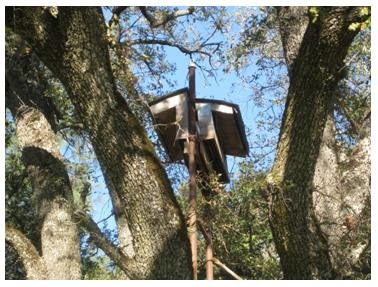
Greg surveyed the situation and built a bat house of his own design, to provide a more attractive alternative to our little friends. He mounted the house in the winery eaves. And it worked… sort of. The bats moved in and began multiplying and eventually overpopulated the house. Two years later, in 1997, Greg built a second bat house to accommodate the increased population and attached it close to the first bat house. And it worked… sort of. The bats moved in there and overpopulated that house, too. This only became evident during periods of extreme heat. To escape the congested habitat and extreme heat generated inside the house on those afternoons, large quantities of both infant and adult bats would move to the outside of the box and cling on to the outer surface as much as possible. It was very disturbing to witness the infants that would fall to the ground unable to navigate to escape the heat. Efforts to return them to their bat house would prove unsuccessful. In the winter of 1998, the houses were removed from the side of the winery and mounted back-to-back on steel poles partially shaded by Eucalyptus trees to provide a cooler site with better air flow. And it worked… sort of. The number of bats inhabiting these houses was estimated at between 600 & 900 at one point. Occasionally during the summer months, Cindy & I would have friends up to the winery right around sunset. We would set up aluminum chairs and sip wine while waiting for the bats to exit for their evening of feeding. First, one or two would come out followed by maybe 3 or 4 more. And then it was like the order was given to vacate the premises. Over the next minute, the bats poured out of the holes in continuous ribbons. It was very exciting to witness one of nature’s finest moments.

One summer period of extreme heat occurred so early in the day, that the houses were still in the full sun. I was saddened by yet another significant die back, mostly of infants. That winter, we relocated both houses, still on the poles, to the interior section of an old Oak tree by one of our vineyard blocks. This was to provide shade at all times of the day. And it worked… period.
So, we are landlords to two different types of bats; The Mexican Free-tailed bat and the Pallid bat.

I read with interest a recent article (By
ROBERT DIGITALE) in the Santa Rosa Press Democrat about bats. Patricia Winters, president of the Forestville-based California Bat Conservation Fund gave a presentation to grape growers and pest workers on the value of bats in insect management.

The following excerpts are from that Press Democrat article.
RE: The Mexican Free-tailed bats
"She's a little bat," said Winters, known to Bay Area schoolchildren as the Bat Lady. "But she can fly faster than any other bat in the world. And she can fly up to two miles high, and all she eats are crop pests."
Winters showed graphics from Doppler radar and thermal imaging to depict billions of moths moving north from Mexico into southeast Texas at a height of almost two miles. Each night the moths run into what Winters called the largest concentration of mammals on the planet, an estimated 200 million Mexican free-tailed bats living in caves outside Austin and San Antonio.
Only 2 percent of the moths ever make it past the bats, which can fly at speeds of 60 mph, Winters said. One recent study estimated that the bats prevent about $1 billion a year in U.S. crop damage.

RE: Other bats
Winters told the group that a lactating Big Brown female bat, a species found in Sonoma County, can eat twice its weight in insects each night.
Kathy Cowan, who volunteers with Winters, said she has a standard argument for convincing women about the value of bats. She focuses on the work the animals do in pollinating tropical fruit and reseeding rain forests.
"If we didn't have bats," Cowan said, "we wouldn't have chocolate."

=================================================
Click here for the entire article and to see a great picture of a Pallid Bat:
http://www1.pressdemocrat.com/article/20081213/NEWS/812130315

Monday, January 19, 2009

The Black Sheep of the Pina Family

Wikipedia tells us this about the term Black sheep:

Black sheep is an
English language idiom which describes an odd or disreputable member of a group, especially within one's family. The term has typically been given negative implications, implying waywardness.[1] It derived from the untypical and unwanted presence of black woolled individuals in herds of sheep, which was undesirable because wool from such sheep could not be dyed.

All four Pina brothers attended St. Helena public schools, and since there are only about six years separating us, we shared lots of the same teachers. One teacher that we all had was Martel Cooper. He taught the Ag Classes and metal shop. I liked Mr. Cooper, even though after one incident at school, he referred to me as the Black Sheep of the Pina Family. I accepted that he was accurate in his assessment, and carried that burden with me through the years. My guilt lessened over time as I heard more & more stories about the escapades that my brother John participated in. By comparison, my activities were quite tame. So maybe it’s a good thing that the word “sheep”, can be singular or plural. Because I’m convinced that in this instance, the Black Sheep of the Pina Family should be a shared title.

For most of our open–house type events, all four brothers will be there participating. I’ve had as many questions from of our visitors about the 4 brothers, and how they get along running the winery, as about the wine. We’re all very different, but we are able to have lively discussions at our weekly meetings and arrive at consensus decisions fairly well most of the time. Of course it’s easier, quicker and better if they just agree with my views early on in these discussions (And I’m still working at convincing them to adopt that philosophy).

One area we differ on, is our favorite Pina wine. I think I’m alone in preferring the D’Adamo over all the others. Now if I’m having steak or lamb, I might go with the Buckeye Howell Mountain Cab. But since that doesn’t happen very often, I drink more D’Adamo than all of our Howell Mountain, Oakville, Rutherford and Yountville Cabs combined.

With that in mind, I was pleased when the following blog was posted:

http://www.chow.com/wine_and_drinks/5570 (Updated on 1/20/2009)

D’Adamo was finally getting the recognition I felt it deserved. From this, I couldn’t be sure the writer would prefer the D’Adamo over the others. But he thinks it’s pretty good wine so I’ll accept the Don’t Ask/Don’t Tell strategy with his endorsement. In no way can/should it be considered a Black Sheep within the Pina wine family – Not sure I can say the same about brother John.

Thursday, January 15, 2009

Treading Lightly – The Kubota Secret

The Kubota Secret
I have several childhood memories of growing up in the middle of vineyards. One of the images that I’ve carried with me is my father driving a Caterpillar D-2 pulling a disc through the vineyards on a brilliant spring day. There was a lush crop of Mustard, so tall that the tracks of the CAT were not visible – Just the upper half of the tractor floating through the Mustard with my dad at the helm. There was a small flock of red-winged blackbirds following closely, ready to swoop in and snatch earthworms as their world was turned upside down.

Over the years, Pina Vineyard Management (PVM) has had many Caterpillar tractors. They are great machines. In recent years, we’ve been adding some John Deere tractors to the fleet. The overwhelming factor when purchasing these tractors was function. They were chosen to get the job done, pure & simple. And PVM also has lots of Kubota tractors chosen for the same reason.

In the Spring of 2006, the local Kubota tractor dealership approached us with a unique proposal. Kubota had been working on a new tractor and they needed somebody to give it a well rounded field test: Work it hard, find its strengths & weaknesses – If you find problems, we want to know. Say no more, just give us the key. But, they said, there is one more thing:
Keep it a secret.

The tractor was delivered on an overcast day after a period of rain. It came with at least a half-dozen Kubota Engineers that were eager to test the metal of their baby. Their enthusiasm was admirable. After several hours they left and headed back to Japan.

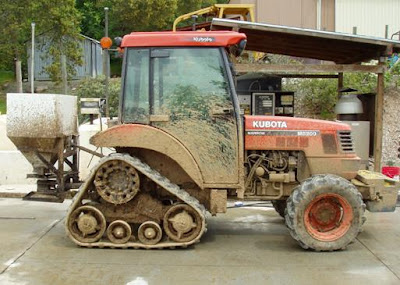
After looking at the top picture, you may be wondering what the big secret is. It’s the side-view picture that will give you the answer.
Yes, a wheel tractor that also has tracks or a tracklayer that also has wheels.
Pina Cellars (in cooperation with Pina Vineyard Management) hosted the Kubota new tractor unveiling for the media and some local farmers. In the picture above, that’s brother Davie explaining our involvement with the project and describing our “testing” of the new Kubota Power Krawler.

You can check out the Kubota website for more information:
http://www.kubota.com/f/aboutkubota/prl67.cfm


If you do, note the pictures that were taken in the PVM vineyard that sits high above Miner Winery. It’s a bit too steep to feel comfortable in most tractors.


After a day of testing - Kubota’s dirty secret

This is beginning to sound too much like a Kubota advertisement, so I’ll get to the point that I intended to make. And that is that new vineyard equipment is changing to meet the needs of new vineyards.
New vineyards/old vineyards, what’s the difference?

Well, for starters, new vineyards are typically planted in much closer rows than old vineyards. My dad’s old CAT D-2 wouldn’t fit down the rows of most vineyards planted these days. As a result, many tractor manufacturers are now offering narrow gauge tractors.
A growing concern among growers is soil compaction. Those old CAT D-2s looked pretty heavy, and they were, BUT the weight was distributed over a much larger area than today’s wheeled tractors. And that’s one of the big selling points of the new Kubota Power Krawler. It doesn’t compact the soil as much as a similar sized wheel tractor. How innovative of Kubota you say? Well, yes and no. It’s not like they invented the concept.

Photo courtesy http://www.fightingiron.com/FI-Heritage.htm


PVM gave the Krawler a thorough testing with several different implements and we were impressed. PVM now owns one of the new Kubota Power Krawlers, and will continue testing another production model for Kubota. Great machines – but I’m thinking the image of the driver sitting in a “climate controlled” cab with the high tracks visible while discing down the mustard is going to fall short of my recollections from the good old days.